
































What are the different types of kimonos for women?
The women's kimono holds a central place in traditional and contemporary Japanese clothing. It comes in several forms, adapted to ages, occasions, and levels of formality. Find the different types of women's kimonos in this review.
Japanese Kimonos for Women: The Different Types
Japanese women's kimonos come in a wide variety of styles, each associated with well-defined uses and levels of formality. This richness in clothing is part of a tradition where each cut, fabric, and pattern has a precise function. To better visualize these distinctions, find the main types of women's kimonos in the table below.
|
Type of women's kimono |
Level of formality |
Main characteristics |
Occasions of use |
|
Furisode |
Very formal |
Long sleeves, colorful and elaborate patterns, often silk fabric |
Coming-of-age ceremonies, weddings (for unmarried women), official events |
|
Houmongi |
Formal to semi-formal |
Continuous patterns over seams, balanced elegance |
Weddings, receptions, official visits |
|
Tomesode |
Very formal |
Patterns only on the lower part, marked sobriety |
Weddings (married relatives), important family ceremonies |
|
Iromuji |
Semi-formal |
Plain kimono, sometimes with very subtle patterns |
Tea ceremony, cultural events, traditional rites |
|
Yukata |
Casual |
Light cotton fabric, worn without complex underlayers |
Summer festivals, fireworks, summer relaxation |
How to wear a women's kimono correctly?
Wearing a women's kimono requires precision and consistency in every detail. The balance between volumes, colors, and accessories directly influences the elegance of the outfit. A good mastery of the basics helps to avoid common mistakes and frequent errors.
Choosing the right women's kimono accessories
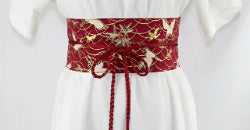
The harmony of a women's kimono largely depends on the choice of accessories. Each element complements the outfit and enhances its elegance without overwhelming the overall look. The obi belt plays a central role as it structures the silhouette and draws the eye. Its color and pattern must match the kimono without creating excessive contrast. Traditional undergarments, such as the nagajuban, ensure a neat finish while preserving the main fabric. Attention to these details helps achieve a coherent outfit that respects the codes.
Women's kimono accessories also include discreet but essential elements. Tabi socks and zori sandals provide a suitable finish for formal or semi-formal occasions. Delicate hair ornaments complete the ensemble with subtlety. The choice of materials and colors should remain measured to maintain a certain sobriety. A well-thought-out combination enhances the kimono without diverting attention from its structure and patterns.
Mastering the fit of a women's kimono
A precise fit guarantees a neat appearance and respects the traditional codes of the women's kimono. The length should cover the ankles without dragging on the ground, ensuring comfort and elegance. The overlapping of the garment remains essential, with the left panel placed over the right. This simple rule avoids any style errors. The alignment of the seams along the body also contributes to a clean and structured silhouette.
Wearing a kimono involves a few essential gestures that ensure a harmonious fit. The obi belt plays a central role in structuring the ensemble. Particular attention to the folds and tension of the fabric helps to avoid a disorganized appearance. Therefore, you should:
- adjust the length of the kimono so that it grazes the ankles without excess;
- correctly position the collar to slightly expose the nape of the neck;
- tighten the obi firmly without creating visible folds;
- smooth the fabric over the hips to maintain a regular line.
A rigorous adjustment enhances the women's kimono and reinforces the elegance of the traditional garment.
What are the trends for women's kimonos?
The trends for women's kimonos in 2026 are moving towards a more marked fusion between traditional heritage and contemporary influences. Designers are revisiting classic cuts, maintaining iconic lines while introducing graphic patterns inspired by modern Japanese art. Colors are becoming more diverse with bolder associations, blending deep hues and pastel shades. This evolution responds to a growing demand for pieces that can adapt to various contexts, ranging from cultural events to urban uses. The women's kimono thus becomes a garment designed as much for aesthetic expression as for practicality.
At the same time, the materials used are undergoing a notable transformation. Light cotton, linen, and certain blended fibers are gradually replacing exclusively traditional fabrics in everyday models. This adaptation allows for more accessible and comfortable wear, especially in urban environments. Floral patterns remain present but are enriched with more abstract or minimalist compositions, bringing a contemporary touch to the ensemble. The women's kimono is also integrated into wider clothing styles, worn open over modern outfits or paired with Western accessories.
How much does a women's kimono cost?

Source: Freepik
The prices of a women's kimono vary greatly depending on the material, quality of craftsmanship, and the level of tradition desired. An entry-level model in cotton or polyester remains affordable and is often suitable for occasional or festive use. These pieces generally fall within a range of a few tens to a hundred euros. In contrast, handmade silk kimonos reach much higher prices due to the manufacturing time and the artisanal know-how required.
High-end creations can exceed several hundred, or even several thousand euros for the most refined pieces. Ceremonial models, especially those intended for weddings or traditional events, incorporate noble fabrics, complex embroideries, and specific dyeing techniques. The price also reflects the reputation and rarity of the design.