














































Why do Japanese people use floor mats?

Source: Freepik
Japanese people use floor mats as a central element of their interior design. This practice is based on practical, climatic, and cultural reasons deeply rooted in daily life. Japanese mats structure space, enhance comfort, and promote a flexible organization of the home. Understanding this use allows for a different appreciation of Japanese housing and its relationship with the floor. In this review, discover the reasons why Japanese people use floor mats.
Why do Japanese people prefer floor mats?
Japanese people use floor mats to address very specific climatic, spatial, and cultural constraints. This choice structures the organization of the home and influences daily habits, from rest to shared family moments. Several specific reasons help to understand why the Japanese mat occupies a central place in traditional and contemporary housing.
Better thermal comfort
The choice of floor mats in Japan primarily meets a need for thermal comfort adapted to seasonal variations. Winters can be cold and humid, while summers are heavy and stifling. In this context, the Japanese mat acts as a natural insulating layer between the body and the floor. It limits the sensation of cold rising from the floor and creates a more pleasant surface for sitting or lying down. This approach improves well-being without relying solely on heating.
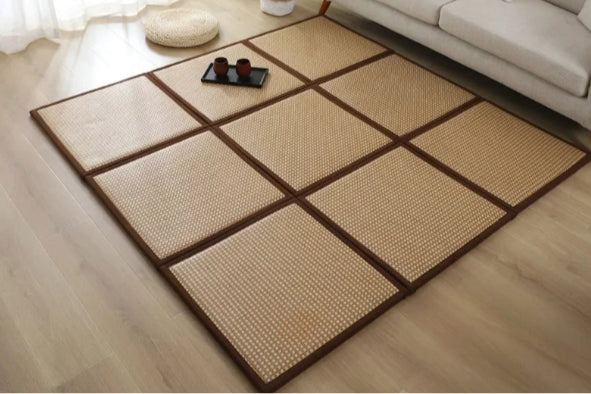
Traditional materials, such as compressed rice straw used in tatami, have interesting properties. They retain heat in cold periods and allow air to circulate when temperatures rise. The Japanese mat thus contributes to the thermal balance of the home while maintaining a feeling of soft and temperate contact under the feet.
Intelligent optimization of interior space
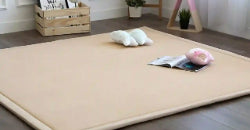
In Japanese homes, the layout is based on a rational use of every square meter. Japanese people use floor mats to structure rooms without cluttering them with massive furniture. This approach promotes freer circulation and a sense of openness. The Japanese mat defines living areas while offering great freedom of arrangement. It becomes a functional base that often replaces several fixed pieces of furniture. This organization allows for easy transformation of the same room throughout the day.
Ideal modularity for small spaces
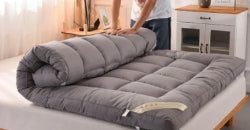
In generally compact Japanese homes, the floor mat allows for quick transformation of space according to needs. It offers a flexible and versatile surface that serves equally for rest and daily activities. By unfolding a futon on the mat, the room instantly converts into a bedroom, while putting it away in the morning frees up the floor for other uses. This flexibility optimizes every available square meter and avoids clutter associated with fixed or bulky furniture.
The Japanese mat also integrates into a modular approach to interior design. Its lightweight and compact design facilitates movement according to the activity, whether it involves:
- meals;
- moments of relaxation; or
- exercises.
Residents can thus adapt the space without having to invest in complex furniture. This modularity contributes to creating functional and harmonious interiors, where the floor becomes a true extension of daily use. The practicality of the mat lies in its ability to simultaneously meet the needs for comfort, organization, and circulation in small homes, while maintaining a clean and natural aesthetic.
A strong anchor in Japanese tradition
For several centuries, the Japanese tatami has occupied an essential place in interior architecture and the Japanese way of life. Tatami mats were standardized as early as the Edo period, defining room dimensions and organizing space harmoniously. Their presence influences furniture arrangement, room circulation, and even daily gestures. The mat is not just utilitarian. It embodies a sober and natural aesthetic that reflects the Japanese taste for simplicity and balance.
The use of mats is also a vector of cultural transmission. It accompanies many traditional practices and promotes a soothing atmosphere in the home. The natural fibers and neutral tones contribute to a healthy and harmonious indoor environment. The integration of the Japanese mat is based on principles such as:
- using durable and breathable plant materials;
- maintaining balanced proportions in each room;
- promoting a modular and functional space;
- preserving cleanliness and regular maintenance for longevity; and
- creating a calm and minimalist atmosphere.
This approach demonstrates that the Japanese mat goes beyond its practical function. It constitutes a symbol of tradition, aesthetics, and interior organization unique to Japanese culture.
How to fold and store the Japanese mat?

Source: Freepik
Folding and storing a Japanese mat require special attention to preserve its shape and durability. Lightweight natural fiber models fold gently, respecting the direction of the fibers to avoid sharp creases or deformations. Thicker tatami or mats often require two people to handle them to distribute the weight evenly and reduce stress on the seams. This simple method extends the life of the mat while maintaining its comfort and natural appearance.
The mat should be stored in a dry, well-ventilated area, away from humidity and direct sunlight. Placed flat or vertically depending on its thickness, it remains breathable and healthy. It is recommended to regularly check the condition of the mat, especially the folded areas, to prevent the appearance of marks or mold. These simple steps ensure effective maintenance and keep the Japanese mat ready for daily use, whether it is a futon or a modular living space.
How to care for the Japanese mat?
Regular maintenance is essential to preserve the aesthetic and durability of the Japanese mat. Natural fibers, whether rice straw or reeds, require special care to remain flexible and breathable. Dust and humidity are the main factors of deterioration, so it is important to maintain constant cleanliness while respecting the materials. To prolong the mat's durability, you should:
- gently vacuum in the direction of the fibers to remove dust and impurities;
- regularly air out the room to avoid humidity accumulation;
- clean small stains with a slightly damp cloth, without harsh chemical products;
- turn or move the mat occasionally to prevent localized wear; and
- store the mat in a dry and ventilated area.
By following these precautions, the Japanese mat maintains its natural texture and resistance over time. Regular maintenance also helps to maintain a healthy and pleasant indoor space, while enhancing the traditional and warm appearance of this type of covering.
Where to buy a Japanese mat?
Japanese mats are available in many specialized stores, whether physical shops or online platforms dedicated to Asian home goods. Traditional points of sale often offer authentic models made from natural fibers, such as rice straw tatami or modern versions made of woven rushes. These stores allow you to touch and examine the texture, thickness, and flexibility of the mat before purchasing, which ensures a choice better suited to your needs and the dimensions of your interior space.
Online, a wide range of models is accessible, from classic mats to modular contemporary versions. Specialized websites provide detailed descriptions of dimensions, materials, and care instructions. Comparisons and customer reviews help in selecting a quality, durable Japanese mat that meets traditional standards. Ordering online also provides easy access to a wide variety of rare or directly imported Japanese models. These options ensure a thoughtful choice adapted to interior design, while respecting the comfort and aesthetics characteristic of Japanese culture.