





























































Sleeping on a tatami mat: is it good for your back and sleep?
Firm, natural, almost flush with the floor: the tatami intrigues anyone dreaming of a Japanese-style bedroom. But is it really comfortable to sleep on a tatami? For your back, for your sleep, for a French apartment? Here is what you need to know before getting started, and above all, how to set it up properly.
In short
Yes, provided you like a firm bed and follow the Japanese way: you don't sleep directly on the tatami, but on a futon placed on top. The tatami provides a stable, cool, and breathable support; the futon provides the softness. Allow for a few nights of adjustment. This sleeping arrangement is less suitable for people who have hip or shoulder pain when sleeping on their side.
Table of Contents
What is a tatami?
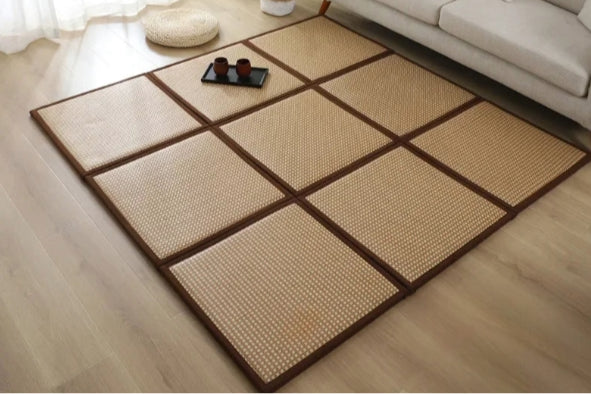
The tatami (畳) is the traditional flooring of Japanese homes. It is a rectangular panel composed of three elements:
- The omote: the top matting, woven from rush (igusa). Green when new, it takes on a golden hue over time.
- The toko: the core, formerly made of compressed rice straw, now often made of foam or an insulating panel, which is lighter.
- The heri: the fabric band sewn along the long sides, which protects the edges.
A tatami always has 2 to 1 proportions. The Kyoto size (kyōma) measures 191 × 95.5 cm, while the Tokyo size (edoma) measures 176 × 88 cm. Tatamis are even used as a unit of measurement: in Japan, people speak of a "6-tatami" room (roku-jō), which is about ten square meters.

How do people sleep on a tatami in Japan?
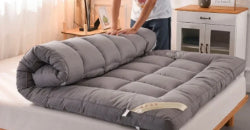
Contrary to popular belief, Japanese people do not sleep directly on the tatami. In the evening, they unfold a futon: a thin, flexible mattress (shikibuton), a duvet (kakebuton), and a pillow (makura), often filled with buckwheat hulls. In the morning, the futon is folded and stored in a closet, the oshiire, and the room becomes a living room again.

The tatami therefore plays the role of a box spring: firm, insulating, and breathable. To learn more about this floor culture, read our article why the Japanese live on the floor.
Sleeping on a tatami, is it good for your back?
Many enthusiasts say they sleep better on a firm bed, which keeps the spine straight and prevents "sinking in". However, there is no scientific evidence that a tatami relieves back pain: it all depends on your body type and sleeping position. If you have pain, ask a healthcare professional for advice before changing your bed.
| More likely for you if… | More likely to avoid if… |
|---|---|
| You sleep on your back or on your stomach | You sleep on your side and have hip or shoulder pain |
| You like firm mattresses | You are looking for a very soft bed |
| You get hot at night (the rush stays cool) | Your home is damp or poorly ventilated |
| You want to free up space during the day | You have difficulty getting up from the floor |
Tatami or mattress: a comparison
| Criterion | Tatami + futon | Bed with mattress |
|---|---|---|
| Firmness | Firm | Choice of firm to soft |
| Height | Flush with the floor | 40 to 60 cm |
| Space | Stored during the day | Permanently occupies the room |
| Summer | Cool, the rush breathes | Can get hot |
| Maintenance | Air out the futon, monitor humidity | Flip the mattress |
| Atmosphere | Zen, minimalist | Classic |
Our Japanese tatamis
 Japanese Rush Tatami
€150.99
 Traditional Tatami
€149.99
 Long Tatami for Living Room and Bedroom
€174.99
How to set up a tatami for sleeping
- 1Choose a dry, flat floor: parquet, tile, or a low slatted bed base. Avoid thick carpet and damp rooms.
- 2Place the tatami and let it air out for a few hours: new rush has a grassy smell that fades quickly.
- 3Add a futon or thin mattress on top. A 1 to 2 cm thick tatami mat, like those found in Europe, is not enough on its own for sleeping.
- 4Fold up or lift the futon in the morning to let the tatami breathe and prevent dampness.
- 5Rotate the tatami every few months so that it wears and patinas evenly.
Can you put a sofa or bed on a tatami? Yes, but the feet of heavy furniture leave marks and crush the rush. Slide wide pads underneath. And on a bamboo mat? It is possible if the whole thing remains dry and flat, but a hard floor remains the best base.
If you cover an entire room, respect the Japanese rule of arrangement: four corners must never meet at the same point.

Are you hesitating between a real tatami and a Japanese-inspired mat? Our article tatami or modern Japanese mat helps you decide.
How to care for a tatami
- Vacuum in the direction of the weave, without a rotating brush, once or twice a week.
- Wipe with a barely damp cloth, never wet, then let dry.
- Air out the room every day and avoid prolonged direct sunlight, which fades the rush.
- In case of a stain, blot immediately with a dry cloth, without rubbing.
Find your tatami
Natural rush tatamis and Japanese mats, for the bedroom, living room, or a meditation corner.
View Japanese tatamisFrequently Asked Questions about Tatami
Is it good to sleep on a tatami?
Yes for most people who like a firm bed, provided you sleep on a futon placed on the tatami and allow for a few nights of adjustment. It is less suitable if you have hip or shoulder pain.
Can you sleep directly on a tatami without a futon?
This is not the custom in Japan and it would be very hard. The tatami serves as a base; the futon or a thin mattress provides comfort.
Can you put a sofa on a tatami mat?
Yes, with wide pads under the legs to avoid crushing or marking the rush.
Can you place a tatami mat on a rug?
It is possible if the rug is thin, flat, and dry. On thick carpeting, the tatami mat will move and air circulation will be poor.
How big is a tatami mat?
A traditional tatami mat measures 191 × 95.5 cm (Kyoto size) or 176 × 88 cm (Tokyo size), and is about 5 cm thick.
How much does a tatami mat cost?
In France, expect to pay around €40 for a thin tatami mat, or €150 or more for a large natural rush model. A traditional tatami mat made in Japan costs significantly more.