













































[TEST – unpublished] Japanese dragon: meaning, legends and differences with the Chinese dragon
Majestic, serpentine and master of the waters, the Japanese dragon is everywhere in Japan: on temple ceilings, on shrine fountains, in tattoos and on embroidered jackets. But what does it really symbolize, and how does it differ from the Chinese or European dragon? Here are its legends and its meaning.
In short
The Japanese dragon, ryū or tatsu (竜・龍), is a deity of the water: it brings rain, rules the seas and protects temples. It symbolizes strength, wisdom and protection. It is recognizable by its long wingless serpentine body and, often, its three claws, while the Chinese imperial dragon has five.
Table of Contents
What does the Japanese dragon symbolize?
Coming from China with Buddhism, the dragon blended with Shinto beliefs about water deities. In Japan, it is not a monster to be slain but a benevolent and sacred force:
| Symbol | What it represents |
|---|---|
| Water and rain | It brings the rain necessary for rice paddies; it was prayed to during droughts |
| Protection | It watches over temples and drives away evil spirits |
| Strength and courage | It embodies mastered power, hence its place in tattoos |
| Wisdom | The dragon is an ancient being that knows the secrets of the world |
| Success | The carp that swims up the waterfall becomes a dragon: it is the image of rewarded effort |

Japanese, Chinese or European dragon: how to recognize them?

In Japanese art, the dragon is often depicted with three claws, while the Chinese imperial dragon has five. A legend even tells that dragons lose claws as they move away from China. The Western dragon, meanwhile, has wings, breathes fire and guards treasures: a foe rather than a protector.
The great legends of the Japanese dragon
- Ryūjin, the dragon king of the seas, lives in a palace beneath the ocean, the Ryūgū-jō. That is where the fisherman Urashima Tarō spends a few days… which actually last hundreds of years.
- Yamata no Orochi, the eight-headed serpent-dragon, is defeated by the god Susanoo, who intoxicates it with sake. The sacred Kusanagi sword comes from its tail.
- The crying dragon (naki-ryū) of the Tōshō-gū shrine in Nikkō: painted on the ceiling, it seems to "cry" when you clap your hands just below, thanks to the echo.
The dragon is also the 5th animal of the Japanese zodiac. It symbolizes energy and luck; the next Year of the Dragon will be 2036.
Seiryū, the guardian dragon of the East
In the cosmology inherited from China, four sacred animals, the Shijin (四神), protect the four cardinal points. The azure dragon, Seiryū (青龍), guards the East and spring. The others are the white tiger (West), the vermilion bird (South) and the black turtle (North).
These guardians actually guided urban planning: the ancient capital Kyoto was established in the 8th century according to this symbolic protection, with a river to the east to welcome the dragon. We also find Seiryū painted on the walls of ancient tombs, such as that of Kitora, near Nara.
The dragon in art, tattoos and fashion
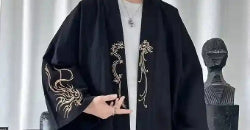
The dragon is one of the favorite motifs of the Japanese art of tattooing (irezumi), where it symbolizes strength and protection. It is also found embroidered on the backs of sukajan, those satin jackets born after the war in the neighborhood of Yokosuka, and on prints and fans.
The Japanese dragon to wear


Japanese dragon tattoo: what you need to know
The dragon is one of the king motifs of irezumi. It is rarely alone: it is associated with other elements that complete its message.
| Association | What it evokes |
|---|---|
| Dragon and koi carp | Rewarded perseverance: the carp becomes a dragon |
| Dragon and tiger | Balance of forces: heaven and earth, spirit and body |
| Dragon and clouds or waves | Its natural element, the power of water and sky |
| Dragon holding a pearl | The quest for wisdom, spirituality and prosperity |
Color also matters: in tattoo culture, the black dragon is often attributed with experience, the golden dragon with wealth and the green dragon with a connection to nature. These interpretations vary depending on the tattoo artist, so talk about it with yours before getting started.
The dragon in manga and films
- Spirited Away (2001): Haku, the spirit of a river, takes the form of a white dragon. A beautiful illustration of the link between the Japanese dragon and water.
- Dragon Ball: Shenron, the dragon that grants wishes once the seven balls are gathered, is inspired by the Chinese dragon, wise and all-powerful.
- Video games and manga constantly feature Yamata no Orochi, the eight-headed serpent, often as the final boss: proof that the old legend still fascinates.
Sukajan, Japanese embroidered jackets
Dragons, tigers and koi carp embroidered on satin: the iconic Yokosuka jacket.
View the sukajanFrequently asked questions about the Japanese dragon
What does the Japanese dragon symbolize?
It symbolizes water, rain, protection, strength and wisdom. It is a benevolent deity, not a monster.
What is the dragon called in Japanese?
It is called "ryū" or "tatsu" (竜 or 龍). The dragon king of the seas is called Ryūjin.
How many claws does a Japanese dragon have?
It is traditionally depicted with three claws, compared to five for the Chinese imperial dragon.
What is the difference between a Japanese dragon and a Chinese dragon?
They are very similar: serpentine body, wingless, linked to water. The Japanese dragon often has three claws and a thinner body; the Chinese dragon, a symbol of the emperor, has five.
What does a Japanese dragon tattoo mean?
Strength, courage, wisdom and protection. Associated with a koi carp, it evokes rewarded perseverance.
What is the most famous dragon in Japan?
Ryūjin, the dragon king of the seas. Yamata no Orochi, the eight-headed serpent, is the most famous of the evil dragons.
What is Seiryū?
The azure dragon, guardian of the East and spring, one of the four sacred animals (Shijin) that protect the cardinal points.
When is the next Year of the Dragon?
The last one was in 2024; the next will be 2036.