




























Japanese lantern: names, meaning and history of light in Japan

The lanterns of Kasuga-taisha in Nara. The shrine has more than 3,000 of them, made of stone or bronze. Image: Gzzz, CC BY-SA 4.0
In Japan, a lantern does not have the same name depending on its use: the andon lights the home, the chōchin is carried or hung outside, the bonbori illuminates festivals, and the tōrō watches over temples and gardens. Behind each of these objects is an era, a material, and a certain idea of light—soft, diffused, and almost never glaring.
What are Japanese lanterns called?
In French, everything is called a “Japanese lantern.” In Japanese, however, there are four main families of traditional lighting. Confusing them would be like calling a cathedral chandelier a “candle”: the chart below puts each one in its place.
|
Name |
Kanji |
Structure |
Where it is found |
Historical reference |
|---|---|---|---|---|
|
Andon |
行灯 |
Paper stretched over a bamboo, wood, or metal frame |
Indoors: placed on the floor, hung on the wall, or kept at the bedside |
Became widespread during the Edo period (1603–1867) |
|
Chōchin |
提灯 |
Split bamboo rolled into a spiral, covered with paper or silk, and collapsible |
Outdoors: carried by hand or hung in front of the house |
First known mention in 1085 |
|
Bonbori |
雪洞 |
Paper lantern with a often hexagonal profile, wide open at the top |
Outdoors during festivals, on a pole or cable |
About 400 painted bonbori each year in Kamakura |
|
Tōrō |
灯籠 |
Stone, bronze, or wood, with multiple tiers |
Temples, shrines, gardens |
Originated in China and initially reserved for Buddhist temples |
The andon, the lamp of Edo homes
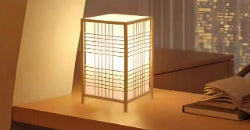
The andon is the quintessential indoor lamp. A sheet of paper stretched over a frame protects a small flame: oil burns in a stone, metal, or ceramic basin, with a cotton or vegetable-fiber wick. Rapeseed oil was the most common. Candles existed, but they were expensive; modest households made do with sardine oil, which was cheaper and noticeably more fragrant.
The object became widespread during the Edo period (1603–1867). Initially carried by hand, it eventually came to be placed on the floor or fixed to the wall. The most common model, the okiandon, takes the form of a vertical box, sometimes equipped with a small drawer for refilling the oil. The Ariake andon serves as a bedside lamp, while the kakeandon, hung under the eaves of shops, displays the merchant's name: a sign of light before its time.
The andon even gave rise to an expression. A hiru andon, or “andon in broad daylight,” refers to someone who seems to be of no use. In adaptations of the story of the 47 rōnin, this label is readily applied to Ōishi Yoshio, who feigns uselessness to better prepare his revenge.
The chōchin, the collapsible lantern
 A bura-chōchin, collapsible bamboo and paper lantern. The spiral design allows it to be flattened in its basket. Image: Samuraiantiqueworld, CC BY-SA 3.0.
The chōchin is the Japanese cousin of the Chinese paper lantern. Its secret lies in its structure: a strip of split bamboo rolled into a spiral, onto which paper or silk is glued. This spiral allows the lantern to be folded completely into the basket at the bottom, like an accordion. Designed for the outdoors, the chōchin is carried by hand or hung in front of the house.
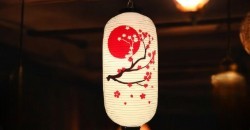
The earliest known mention dates to 1085, and an illustration from 1536 already shows one. Today, one variant has become a signal that every traveler in Japan quickly learns: the akachōchin, the red lantern, indicates an izakaya, one of those small bars where people eat and drink after work. Folklore has also given it a life of its own: the chōchin-obake is a yōkai, a haunted lantern that opens its mouth and sticks out its tongue.
The bonbori, the festival lantern
The bonbori resembles a small paper lampshade, often hexagonal and wide open at the top. It is placed on a pole or hung from a cable along walkways during festivals. The most famous, the Bonbori Matsuri, is held every year at the Tsurugaoka Hachiman-gū shrine in Kamakura: about 400 bonbori are painted there by artists, then lit along the shrine's walkway.
The tōrō, the stone lantern and its meaning
“What is the meaning of a Japanese lantern in a garden?” The answer lies in the tōrō, the stone lantern. The word means roughly “basket of light.” Originating in China, it initially illuminated only the walkways of Buddhist temples in Japan, and a lit lantern there served as an offering to the Buddha. Shinto shrines and then private residences adopted it during the Heian period (794–1185). Between 1568 and 1600, tea masters made it a garden ornament, and that is how it made its way into our Zen gardens.
A complete tōrō is not merely a decorative stack: its five tiers represent the five elements of Buddhist cosmology. From the top to the base:
-
Kū, emptiness (or ether): the bulb-shaped jewel at the top, resting on a lotus-flower support. It points toward the sky.
-
Fū, wind: the roof, called kasa, which caps the firebox. Its corners sometimes curl into volutes.
-
Ka, fire: the firebox, hibukuro, literally “fire bag,” where the flame burned. It is the only part that is never missing.
-
Sui, water: the shaft that elevates the lantern. Some low lanterns placed on the ground do not have one.
-
Chi, earth: the base, in contact with the ground.
The most spectacular of these ensembles is found in Nara, at the Kasuga-taisha shrine, founded in 768. More than 3,000 stone and bronze lanterns line its walkways and galleries. They are all lit together only twice a year: at Setsubun Mantōrō, on February 3, which marks the transition from winter to spring, and at Chūgen Mantōrō, on August 14 and 15, during Obon. Devotees hang their wishes on them before they are lit. The lantern style born here, the Kasuga-dōrō, tall and slender, can now be found throughout the country.
Tōrō nagashi: the floating lanterns
 Tōrō nagashi: paper lanterns entrusted to the current on the last evening of Obon. Image: Laika ac from USA, CC BY-SA 2.0
On the last evening of Obon, the festival of the deceased, many cities place lit paper lanterns on rivers. This is tōrō nagashi, literally “flowing lanterns.” Belief holds that they guide the souls of the departed to the other world. White lanterns honor the dead of the past year. The ceremony also takes place on other dates, notably in Hiroshima in memory of the victims of the atomic bombing.
Washi and “In Praise of Shadows”: why this light is so soft
 Washi paper making in Echizen, Fukui Prefecture. Image: TR15336300101, CC BY-SA 4.0
We often speak of “rice paper lamps.” The expression is misleading: traditional Japanese paper, washi, has nothing to do with rice. It is made by hand from the fibers of the paper mulberry. The fibers are separated, soaked in clear river water, and then filtered through a bamboo screen. This craftsmanship, passed down through generations in artisan families, is inscribed on UNESCO’s Intangible Cultural Heritage of Humanity list. It can be found in letters and books, but also in partitions, screens, and sliding doors.
This paper changes everything about the light. In 1933, the writer Jun'ichirō Tanizaki published In Praise of Shadows (In'ei Raisan), a short essay that became cult among architects and decorators. In it, he contrasts a West that always seeks more clarity with a Japanese aesthetic that cultivates twilight and its nuances. He notes that Western paper reflects light, while Japanese paper absorbs it. That is the entire effect of a lantern: the flame is not seen, and the light seems to come from the paper itself.
From Edo to design: Isamu Noguchi's Akari
 Akari light sculptures on display at the Noguchi Museum in New York. Image: Heartleafphilodendron, CC BY-SA 4.0.
In 1951, the Japanese-American artist Isamu Noguchi visited Gifu, a city specializing in paper lanterns. Electricity was making these objects obsolete, and the mayor asked him to modernize them. Noguchi replaced the candle with a light bulb and used wire to give the forms the appearance of sculpture. He named them Akari, “light” in Japanese.
The success was immediate, both in Japan and abroad. The lamps fold and travel flat, like a chōchin. Today, there are more than 200 variants, still handmade in Gifu from Mino washi paper, bamboo, and metal by the Ozeki family. They can be found at the MoMA and the Metropolitan Museum of Art in New York, the Victoria and Albert Museum in London, and the Musée des Arts décoratifs in Paris. Most of the “paper ball” pendant lights in our living rooms descend, directly or indirectly, from this encounter between an artisan city and a sculptor.
Bringing this light into your home
There is no need to live in a wooden house to recapture the spirit of Japanese lanterns. A few principles are enough, and they all come from what has preceded:
-
Diffuse rather than illuminate. A lampshade made of paper, fine fabric, or natural fibers hides the source and softens the light, just like the sheet of the andon.
-
Choose a warm light. A warm-white bulb, around 2700 K, comes close to the golden hue of flames from days gone by.
-
Multiply low light sources. Rather than a powerful ceiling light, use several sources at eye level or lower: a floor lamp, a wall sconce, a bedside lantern. This recreates the areas of shadow that Tanizaki championed.
-
Rely on natural materials. Paper, bamboo, rattan, and light wood extend the wabi-sabi aesthetic, the beauty of the imperfect and the weathered.
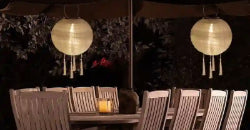
For the living area, a large paper or bamboo pendant light above the table plays the role of the central lantern. If you are looking for this type of lighting, publishers such as Maison Aurore offer Japanese and Japandi pendant lights made of paper, bamboo, or rattan, in this spirit of soft light. And for a more authentic touch, a real chōchin or a small stone lantern in the garden creates a link to tradition.
Quiz: will you recognize each lantern?
Possible choices for each question: andon, chōchin, bonbori, tōrō, akachōchin.
-
Bamboo spiral outdoor lantern that can be folded into its basket.
-
Edo-period indoor lamp, paper stretched over a frame, rapeseed oil flame.
-
Stone lantern of temples and gardens, whose tiers represent the five elements.
-
Red lantern hung in front of an izakaya.
-
Often hexagonal festival lantern: about 400 are painted each year in Kamakura.
Answers: 1 chōchin, 2 andon, 3 tōrō, 4 akachōchin, 5 bonbori. In the HTML version, the quiz is interactive and displays the score.
Frequently asked questions
What is the traditional Japanese lamp called?
It all depends on its use. The indoor lamp is the andon (行灯), the collapsible outdoor lantern the chōchin (提灯), the festival lantern the bonbori (雪洞), and the stone lantern of temples and gardens the tōrō (灯籠).
What is the meaning of a Japanese lantern?
In temples, a lit lantern was an offering to the Buddha. The stone tōrō symbolizes the five elements: earth, water, fire, wind, and emptiness. During tōrō nagashi, floating lanterns guide the souls of the deceased at the end of Obon.
How does a Japanese lantern work?
A light source, once an oil flame or a candle, today a light bulb, is surrounded by paper stretched over a bamboo, wood, or metal frame. The paper protects the flame from the wind and diffuses the light. On the chōchin, the frame is a bamboo spiral that allows the lantern to be folded.
Is the paper of Japanese lamps rice paper?
No. Traditional paper, washi, is made from the fibers of the paper mulberry. The expression “rice paper” is a common misuse of language in the West.
What is the real Japanese lantern?
There is not just one. If you are looking for the one we imagine when we think “Japanese lantern,” round, made of paper, and collapsible, it is the chōchin. The Akari lamp by Isamu Noguchi, created in 1951 in Gifu, is its most elizabeth.